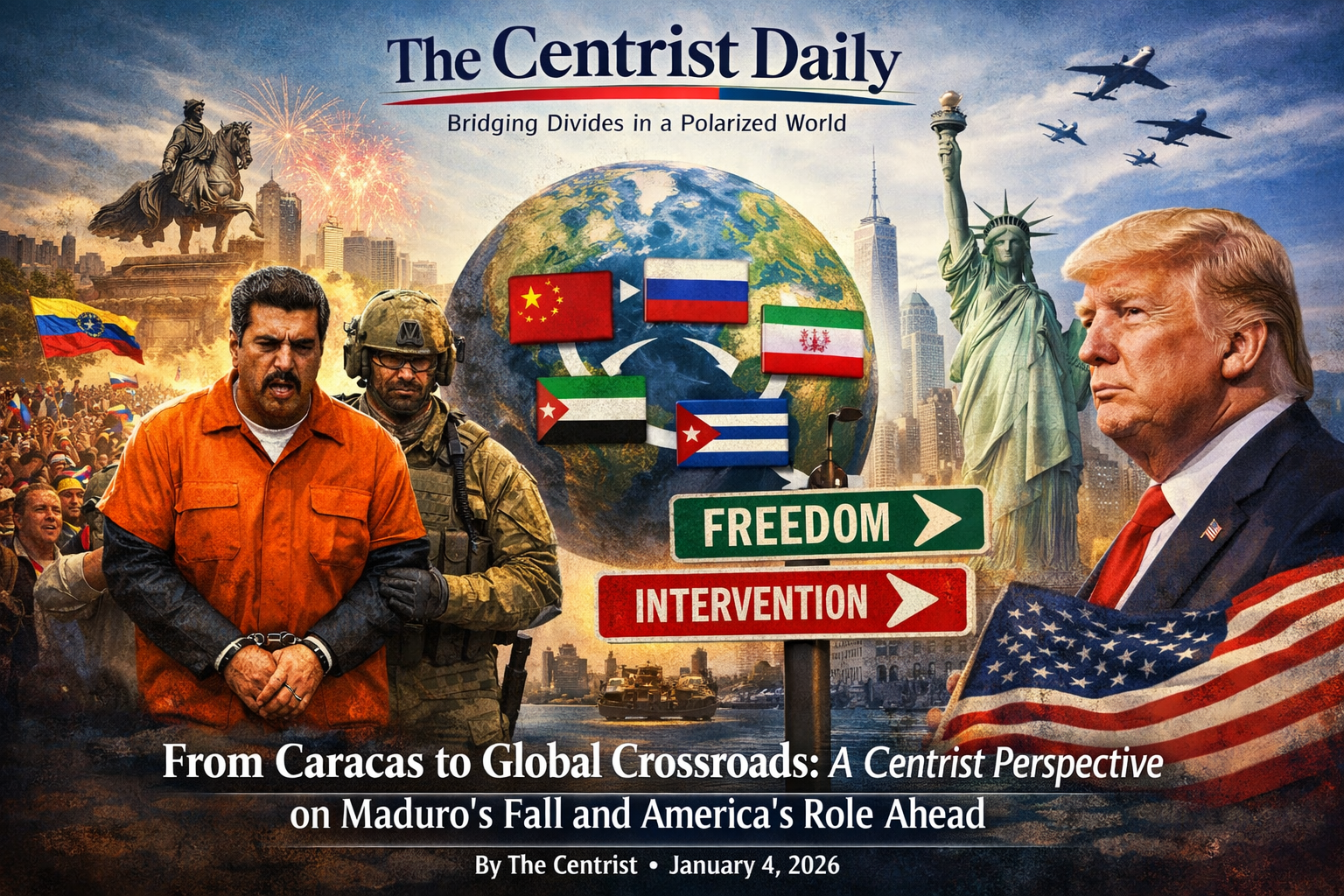
From Caracas to Global Crossroads: A Centrist Perspective on Maduro’s Fall and America’s Role Ahead
In a weekend that reshaped the geopolitical landscape, President Donald J. Trump’s administration executed a daring operation: U.S. special forces extracted Venezuelan leader Nicolás Maduro and his wife from Caracas, delivering them to New York for prosecution on long-standing drug trafficking charges. What followed was a global eruption of celebration and condemnation—Venezuelans and their diaspora flooding streets in Caracas, Miami, New York, Spain, and Argentina in joyous relief, while partisan lines in the U.S. hardened like never before. Republicans hailed it as a triumph against tyranny, a bold stroke for freedom. Democrats decried it as unconstitutional overreach, an authoritarian flex by a president they view as inherently flawed.
As The Centrist, I occupy that increasingly lonely middle ground. I lean in favor of this action—not out of blind allegiance to Trump, but because Maduro’s regime has been a narco-dictatorship that starved its people, rigged elections, and silenced dissent through murder and repression. I’ve spoken at length with Venezuelan neighbors who’ve fled here, building lives in the U.S. oil industry after Maduro’s illegal power grab decimated their homeland. Their stories underscore a truth: This wasn’t just about drugs; it was about liberating a nation from a tyrant who flooded the world with cocaine while his citizens suffered. Yet, centrism demands nuance. We must scrutinize the means, the motives, and the path forward, lest this victory sows seeds of greater division or exploitation.
In this article, we’ll unpack the implications through a balanced lens: America’s role as global enforcer of freedom, the legal footing of Trump’s move, the Democrats’ reflexive opposition, the Republicans’ duty to act ethically, and a vision for leveraging this moment to foster a more cooperative world order.
1. The United States as Planetary Policeman: A Double-Edged Sword of Freedom
For over a century, the U.S. has positioned itself as the world’s guardian of liberty, intervening in sovereign nations to topple despots and promote democracy. From the Spanish-American War in 1898, which sparked occupations in Cuba and beyond, to the Cold War-era operations in Latin America, this role has yielded both triumphs and tragedies. The ouster of Maduro fits this pattern: A swift strike against a regime accused of narco-terrorism, echoing the 1989 invasion of Panama to capture Manuel Noriega on drug charges or the 1983 Grenada intervention to protect U.S. citizens and restore order.
Proponents argue it’s essential—America’s military might deters tyrants and upholds human rights. Without it, regimes like Maduro’s thrive, exporting instability through drugs, migration, and alliances with adversaries like Iran and China. Critics, however, warn of imperialism: Interventions often lead to power vacuums, resentment, and unintended consequences, as seen in Iraq or Libya. As a centrist, I see merit in selective policing. Maduro’s fall could stabilize Venezuela’s oil-rich economy, reduce drug flows to the U.S., and inspire oppressed peoples globally. But it must be paired with multilateral support—perhaps through the UN or OAS—to avoid unilateral hubris. Freedom isn’t imposed; it’s nurtured. If this signals a renewed U.S. commitment to human rights without endless occupation, it could redefine our role for the better.
2. The Constitutionality of Trump’s Actions: Precedent Over Perfection
Democrats have lambasted Trump’s operation as an unconstitutional invasion, a flagrant abuse of power. Yet, history reveals this is far from unprecedented. The Constitution grants Congress the power to declare war (Article I, Section 8), but presidents have long bypassed it for limited actions, citing their role as Commander-in-Chief (Article II, Section 2). The 1973 War Powers Resolution aimed to curb this, requiring notification and limiting engagements to 60-90 days without approval, but enforcement has been spotty.
Consider these bipartisan examples:
- Harry Truman (D, 1950): Deployed troops to Korea without declaration, relying on UN resolutions. Over 36,000 Americans died in a “police action” that lasted years.
- Lyndon B. Johnson (D, 1960s): Escalated Vietnam without a formal war declaration, using the Gulf of Tonkin Resolution as cover—later revealed as misleading.
- Ronald Reagan (R, 1983): Invaded Grenada without congressional approval, citing threats to U.S. students.
- George H.W. Bush (R, 1989): Launched Operation Just Cause in Panama, arresting Noriega on drug charges—mirroring Maduro’s case—without prior declaration.
- Bill Clinton (D, 1999): Ordered NATO bombings in Kosovo without congressional authorization, a humanitarian intervention against ethnic cleansing.
- Barack Obama (D, 2011): Intervened in Libya without approval, leading to Gaddafi’s fall but also chaos.
Even Trump himself ordered strikes on Syria in 2017 and 2018 without Congress. These instances show that while Trump’s move pushes boundaries, it’s within a well-trodden executive tradition. Centrists should advocate for reform—strengthening the War Powers Resolution—to ensure transparency without paralyzing decisive action against clear threats.
3. The Left’s Blind Spot: Anti-Trump Zeal Over Objective Assessment
Democrats’ uproar feels less about Venezuela and more about Trump. They decry the lack of transparency and legality, yet ignore similar actions by their own. This reflexive hatred—where everything Trump touches is tainted—undermines credible critique and alienates centrists. Why research Maduro’s atrocities or Venezuelan jubilation when “Orange Man Bad” suffices?
Contrast this with overlooked Democratic missteps. Bill Clinton, lionized today, faced impeachment for perjury and obstruction over the Monica Lewinsky affair—an immoral abuse of power in the Oval Office. His 1998 missile strikes on Sudan and Afghanistan were accused of distracting from the scandal. Kosovo bombings? Unauthorized and ethically murky. Other examples: Lyndon Johnson’s Vietnam deceptions, or Obama’s drone program, which killed civilians without due process. Democrats conveniently forget these when attacking Trump, revealing a partisan amnesia that erodes trust. As a centrist, I urge the left: Separate the man from the merit. Maduro’s removal aids Venezuelan refugees and curbs drugs—outcomes progressives should champion, not dismiss.
4. Republicans’ Burden: Freedom Fighters, Not Fortune Seekers
While I applaud Trump’s resolve, Republicans like the President, Senator Marco Rubio, and Pete Hegseth (Secretary of War? 👎 terrible title by the way) bear immense responsibility. This can’t devolve into profiteering. Venezuela’s oil wealth mustn’t become a U.S. spoils system; instead, aid should focus on self-sustainability—rebuilding institutions, fighting corruption, and fostering fair elections.
Historical pitfalls abound: Post-intervention plundering in Iraq bred insurgency. Republicans must prioritize humanitarian aid, debt relief, and partnerships with Colombia (which has sheltered millions of Venezuelan refugees) over extraction deals. Opposition from China, Iran, and even Colombia (wary of instability) underscores the need for diplomacy. True purveyors of freedom invest in stability, not exploitation. If mishandled, this could validate critics’ imperialism charges and squander global goodwill.
5. Tying It Together: A Centrist Vision for a New Era of Global Cooperation
Maduro’s fall isn’t an endpoint—it’s a pivot. As The Centrist, I see opportunities to extend this momentum ethically. In Iran, teetering on collapse amid protests, U.S. pressure could support reformers without invasion, shifting power from theocrats. Cuba’s aging regime, reliant on Venezuelan oil, might crack under isolation—offering sanctions relief for democratic reforms.
This could pressure Russia and China: Ukraine’s stalemate demands renewed U.S. resolve to enforce borders, while Taiwan’s defense deters Beijing’s annexation bids. Imagine a “new world order” not of dominance, but collaboration—where superpowers align on human rights, climate, and trade for humanity’s betterment. The U.S. can’t police alone; alliances like NATO and the Quad must evolve.
Unity eludes us since 9/11 or the 1980 Miracle on Ice, but centrism bridges gaps. By endorsing Trump’s action while demanding accountability, we honor Venezuelan freedom without partisanship. Let’s unpack not just Maduro’s bags, but our divisions—for a world where liberty isn’t exported by force, but embraced by all.